
By Connectly Team

Conversational automation has become essential for digital retail, but the choice between traditional chatbots and AI agents can determine whether your operation merely automates tasks or truly transforms the customer experience into revenue.
Although both are digital service tools, they operate on completely different logic. Chatbots follow fixed scripts; AI agents understand context, learn from data, and adapt to each interaction. This difference directly impacts conversion, efficiency, and LTV.
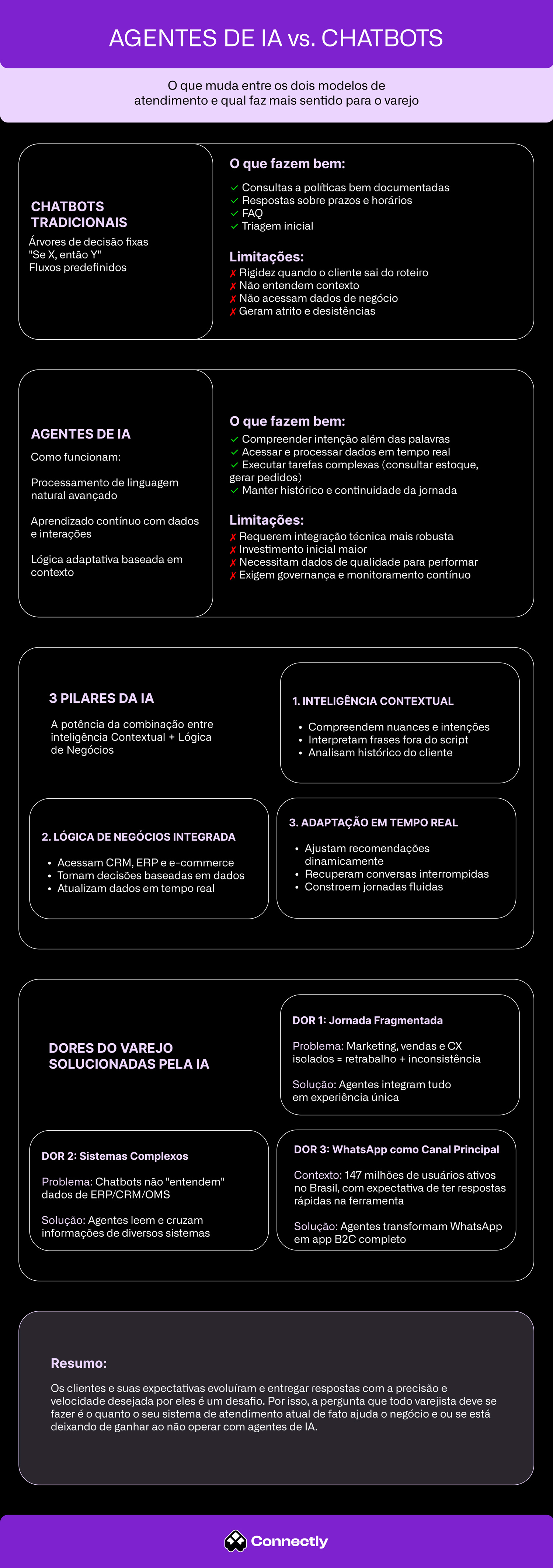
In the full infographic at the end of this post, you will see a side-by-side comparison of the capabilities, limitations, and use cases of AI and traditional chatbots in retail — especially on WhatsApp, the primary relationship channel for the Brazilian consumer.
Deterministic chatbots work well for predictable, repetitive scenarios such as policy queries, store hours, and FAQs. They are efficient for initial triage and maintain operational consistency at low cost.
The problem arises when the customer steps outside the expected flow — which is common in Brazilian retail, where 70% of carts are abandoned. In these moments, the rigidity of the chatbot creates friction, drop-offs, and lost recovery opportunities that require contextualization.
AI agents go beyond automation. They understand intent, access CRM, ERP, and e-commerce data, and make decisions based on business logic. This means recommending the right products at the right time, executing complex tasks such as real-time inventory queries, and maintaining a continuous history of the customer journey.
This autonomy transforms digital service into a sales tool, shortens the commercial cycle, and absorbs large volumes of demand without losing quality — especially on WhatsApp, where 147 million Brazilians expect speed and personalization.
Brazilian retail faces three structural challenges that chatbots cannot address:
The answer depends on your objective. If you only want to automate simple responses, chatbots may suffice. But if the goal is to increase conversion, reduce CAC, and elevate customer experience with real intelligence, AI agents are the standard the market is already adopting.
Customers have evolved. Their expectations have too. The question every retailer must ask is: how much does the current system actually help the business — or how much are you leaving on the table by not operating with AI agents?

©️ 2025 All rights reserved. Connectly Inc. Engineered with ❤️, globally.
Company
Let's get started