
By Connectly Team
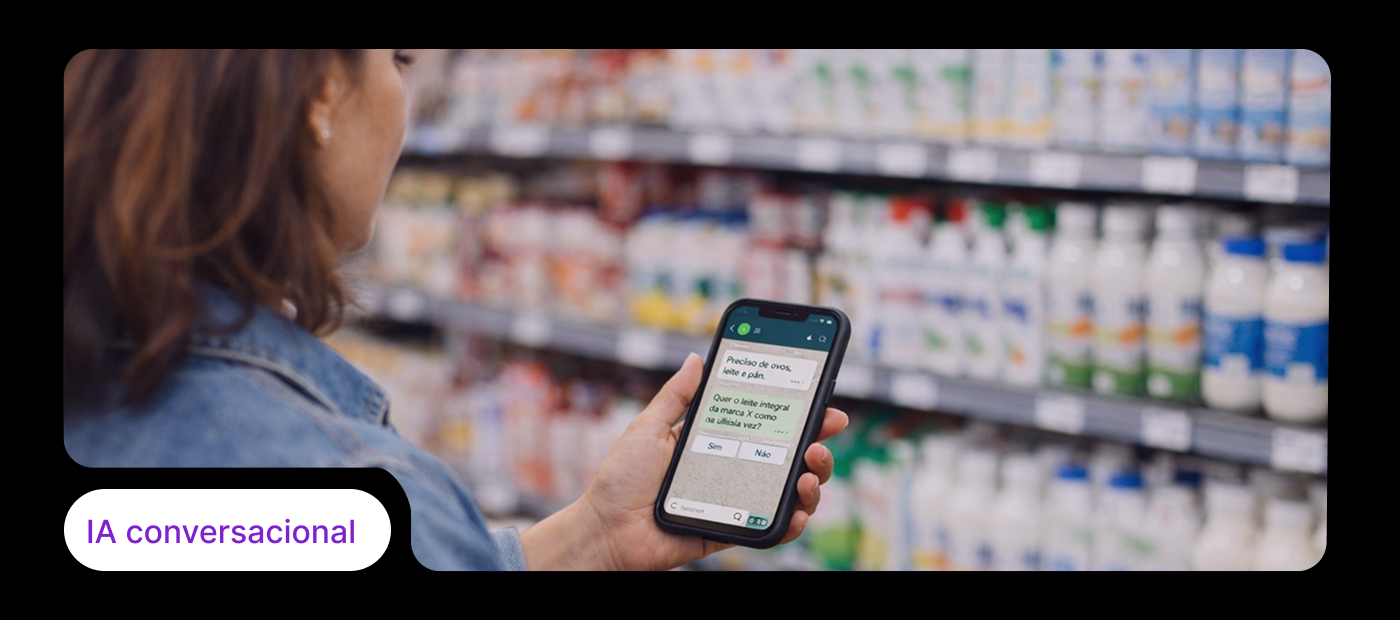
Thinking about how technology can support the shopping journey in supermarkets and pharmacies presents a unique challenge. A typical characteristic of these sectors means that solutions with a major impact in other retail segments have a reduced impact here: the purchase decision usually happens before the customer opens the online channel or walks into the physical store. They do not want to "browse to discover" — they want to check items off a list and finish quickly. This is why the use of AI by supermarkets and pharmacies becomes most effective when the technology is calibrated for more efficient item selection — from cart assembly to repurchase.
The opportunities are enormous. Although these are sectors that generate a significant share of the national economy, they are marked by fragmentation and high competitiveness, making any innovation a critical factor for improving margins and positioning. Brazil's more than 400,000 supermarket stores account for the equivalent of 9.12% of GDP. Pharmacies, in turn, generate approximately R$200 billion in revenue, with establishments distributed across almost every municipality in the country.
In this article, we show how AI is a key ally for supermarkets and pharmacies in building a closer relationship with their customers and leveraging a channel already embedded in their daily routines — WhatsApp — to bring convenience and increase sales.
The main difference in consumer experience between physical retail and online shopping is the friction in searching for and organizing items.
In a store, the customer sees categories, compares packaging side by side, and places products in the cart almost without noticing the effort. In the digital environment, each item requires clicks, filters, page scrolling, and reading descriptions.
When we talk about supermarkets and pharmacies — where purchasing is typically goal-oriented and recurring — any friction in this process directly impacts conversion. Making item selection a fluid, conversational, and contextualized experience is therefore the primary lever in the online journey.
In practical terms, "selecting items" means turning purchase intent into a full cart with minimum friction. In a supermarket, this usually looks like a loose list ("eggs, milk, bread"), while in pharmacies the greater challenge is ensuring timely replenishment ("my blood pressure medication") or answering quick questions ("which vitamin offers the best value?").
The friction is not only in the time it takes the customer to search for every item on the retailer's website or app, but also in more elusive aspects such as finding the right SKU, handling variations (size, brand, concentration), and dealing with unavailabilities.
Technologies from just a few years ago could rarely handle this level of complexity. They were automations based on fixed decision trees — a model that works well when interactions involve predictable questions, but rarely delivers a good shopping experience when responses depend on context, preferences, history, and exceptions.
When we talk about AI for supermarkets, the best way to understand the impact is to see the technology as a "basket concierge." The goal is not to display a massive catalog but to allow the customer, through a natural conversation, to have their order assembled in just a few interactions.
In practice, AI enables types of interaction that, until now, only happened in physical stores:
In this flow, AI-powered product recommendation becomes an ally for completing the list and reducing the time to payment.
In pharmaceutical retail, item selection requires an additional component: governance and compliance — because not everything can be treated as a standard SKU. Items requiring a prescription, sensitive guidance, and verification demand specific prioritization.
Artificial intelligence in pharmaceutical retail works well when it:
Furthermore, since this is a fragmented sector, pharmacy sales automation via WhatsApp becomes a practical way to compete with a better digital experience without relying exclusively on human service.
AI decisions are always made based on signals. In practice, the model combines three layers:
What the customer has shown they prefer — purchase history, recurring brands, price sensitivity, and declared restrictions ("lactose-free," "for children").
What the context indicates — occasion mentioned in the conversation ("barbecue," "back to school"), seasonality, promotional calendar, and location.
What the operation allows — available inventory per store, authorized substitutes, active bundles, and margin rules.
These layers work together to generate suggestions that feel obvious to the customer — because they reflect what they would have chosen anyway — and that are viable for the operation.
In fast-moving and recurring purchase categories, the direct channel gains importance because it reduces friction and dependence on intermediaries. Delivery platforms typically charge commissions that vary by plan (reported scenarios of 12% to 23%), plus online payment fees — all of which compress margins.
WhatsApp is a channel customers are already accustomed to, but it traditionally requires retailers to invest in large service teams to replicate the logic of physical sales. This is where AI for item selection comes in. It is an ally that, without significant human capital investment, turns a WhatsApp conversation into a fast cart — giving the retailer greater control over experience, data, and profitability.
Ultimately, AI for supermarkets and pharmacies is a fundamental strategy for gaining traction in online operations and solving chronic challenges in these types of businesses. When AI acts as an operational concierge, retail reduces friction, improves efficiency, and creates a direct channel that protects both margin and experience.

©️ 2025 All rights reserved. Connectly Inc. Engineered with ❤️, globally.
Company
Let's get started